
It Doesn’t Have to Be This Way
You’re probably wondering what the hell happened.
One day you were a bright-eyed kid, obsessed with music, about to start your first big job in the industry. You told your friends about the cool artists, the cool office, filled with cool people, and about that one time you met someone famous backstage.
Maybe you even moved to a new city. But it was so worth it. And you thought to yourself, “Man, this is it. I’ve made it.”
Then one day you woke up, and you realized you hadn’t made it.
In fact you were barely keeping it together. You were working 12 hours a day, spending your entire waking hours staring at spreadsheets. Your phone was in a constant frenzy, buzzing with demands: “Where’s the master?” “Is this approved?” You were putting out fires, hunting down metadata and assets, and staring into the abyss of Meta Business Manager, thinking to yourself, “I didn’t sign up for any of this.”
Where did things go wrong?
It didn’t happen overnight
Back in ancient times, pre-TikTok and pre-Spotify, the music business was a small world. A handful of retailers decided what you bought, a handful of radio stations decided what you listened to, and when it came to music one TV channel decided what you watched. At the top of it all sat a handful of labels that decided which artists were worthy. If you were in the club, it was great. You recorded an album, played some shows, did some interviews. See you in a few years. If you weren’t…well, good luck to you.
The internet blew that up. Artists could release music on their own terms and reach fans directly. More artists, more music, more choice. What’s not to love?
The problem is that it also changed the job. Releasing a record in 2026 ain’t what it used to be. There’s more opportunity than ever, but every channel, platform and community needs to be fed. Constantly, lest you disappear and be forgotten. And they all want something different. Short-form, long-form, Canvas, clips, motion artwork, Dolby Atmos, livestreams, teasers. The list goes on.
The economics changed too. There are more artists than ever and less revenue for each one. So labels, distributors and managers make up for it with volume: more releases, more artists, more output. Instead of an album every few years, it’s a new single every few weeks. Meanwhile labels are downsizing, and more of the work lands on artists and managers.
In 1988, about 50,000 new songs came out all year. Today, about 106,000 tracks hit streaming services every day.
No wonder everyone ends up with rosters so big they barely have time to do the actual work.
None of it is hard on its own. It’s the constant papercuts that get you: the link no one can find, the release date that moved again, the bio someone needs for the third time. Add them up across half a dozen releases and five different group chats, and suddenly it’s 9pm and you haven’t touched a single thing on your to-do list.
We’ve been there too
When Francis and I started our artist and label services agency, Mega Labs, we figured we’d do things differently. We’d worked at other companies and dealt with the same chaos everyone else struggles with. This time it would be different.
Spoiler: it wasn’t. The more artists we took on, the more we found ourselves dealing with the same problems we’d been dealing with our entire careers.
So we tried the usual fixes. First we hired. It helped a bit, but mostly it meant more people to manage and more channels to keep up with. We tried task managers and shared spreadsheets. Nobody kept them up to date, they didn’t talk to anything else, and the whole thing broke the moment a release date changed.
We knew the system was broken, so we decided to do something about it. We spent months mapping every step in the release process, looking at how information flowed, where things broke down and what could be automated. At the end of it, we had a system to run the agency, built on top of Notion.
That was the first version of Groovedesk.


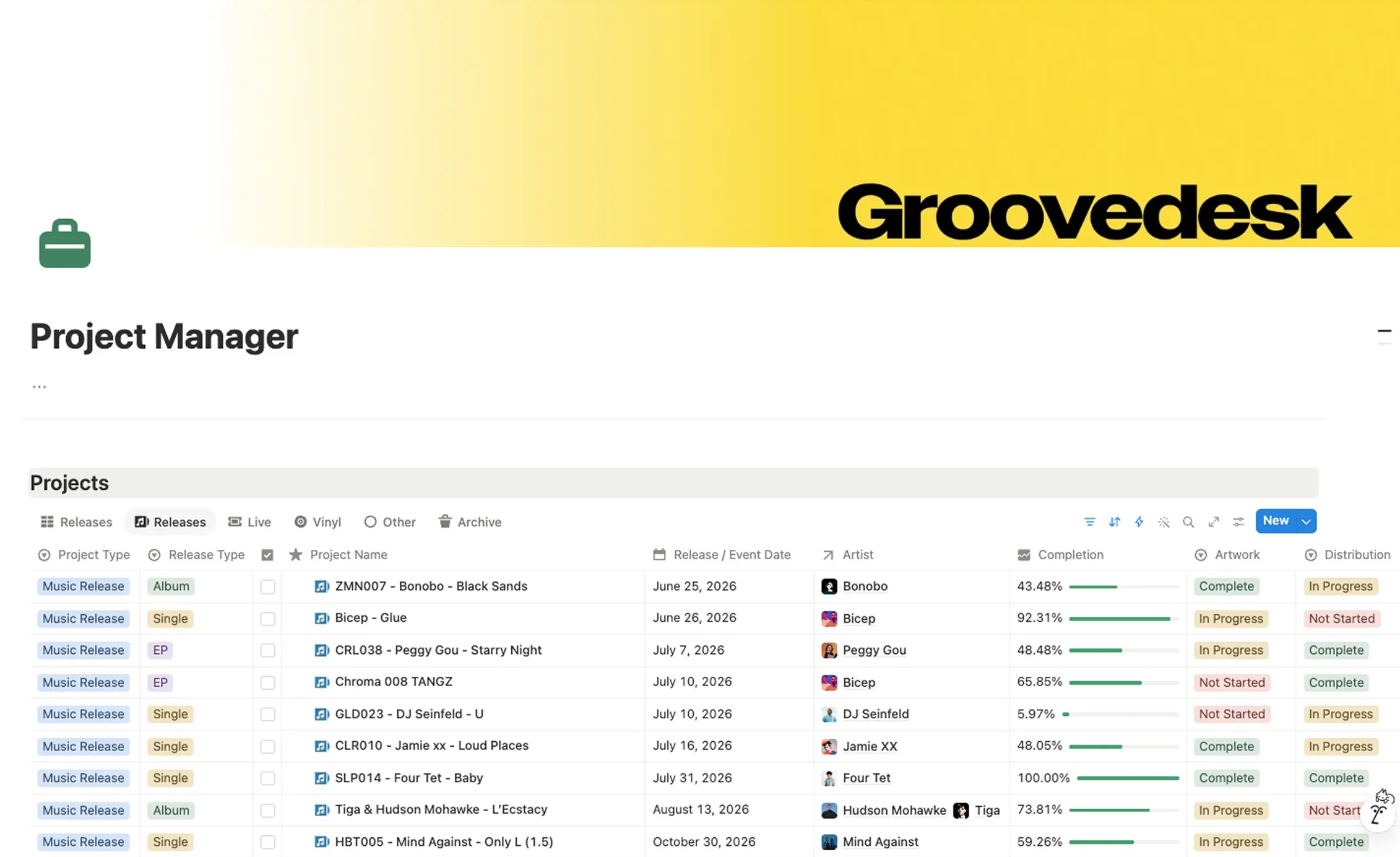
It was awesome. You could set up a release, drop in the date and seconds later every single task and deliverable would automatically be assigned to the right person, with the right due date. Label copy, 8 weeks out. Distro, 6 weeks out. Pitches, 4 weeks out. The first time we moved a release and saw all the due dates move in sync, it felt like magic.
It transformed our business. We could handle more clients, hire more staff, and do a better job on the releases we were running.
We ran over 100 releases through the system for artists like Thirty Seconds to Mars, Cheat Codes, Mind Against, Tiga, Hudson Mohawke and more.
Then other labels started asking if they could use it too. Before we knew it, we were shutting down the agency to build Groovedesk full time.
That was a little over a year ago.
Today there are over 40 music companies running on that original system, including Insomniac Music Group, ATC Management, The Other Songs, EQT, and more.
It wasn’t just us
Since that first version, we’ve talked with more than a hundred people across the industry: labels, managers, distributors, artists, agencies. They all tell us some version of the same story.
“Hey, do you have a link to the master? Hey, do you have a link to this? What’s the status on this?”
“Every year the list of things we have to do doubles. It never gets any shorter.”
“The more releases you’re doing, the more people we bring onto the team, the more artists you sign, the harder it gets.”
“There’s no tool that truly accounts for how people in music work.”
“Everything lives in Apple Notes and email and yeah, I’m kind of sick of it.”
No one we talked to was happy with their system. Well, except for Andrew. Well done, Andrew.
It’s not that people aren’t working hard. There’s just too much, in too many places, across too many releases, all at once.
One release won’t kill you. All of them together will.
The new Groovedesk
But we’ve hit the limits of what Notion can do. It’s become a web of custom automations, and the interface was never built for how deep music workflows go.
So nine months ago we started working on a brand new version of Groovedesk, built from the ground up. We took everything we learned from the first version and packaged it up into a standalone web app. It’s the product we wished we always had, and it launches this fall.
Groovedesk is the intelligent workspace for record labels. It helps you organize and automate music releases so you can spend more time with your artists and less time drowning in admin.
The waitlist is open now if you want in early.
So what’s it like to use Groovedesk?
When you sign up, you load in your roster, and Groovedesk fills in the rest: photos, links, bio, streaming stats. All your artists, all in one place.


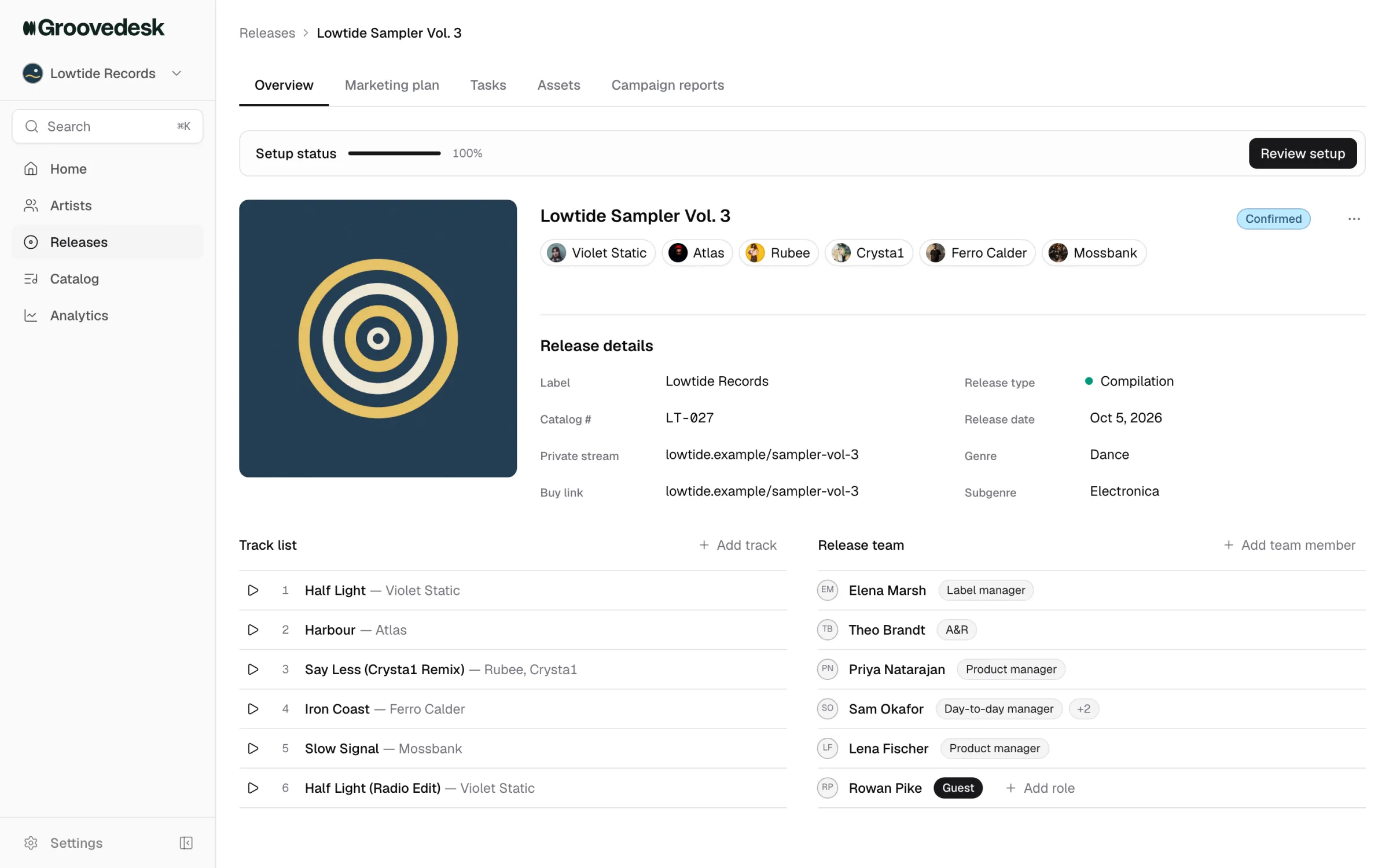
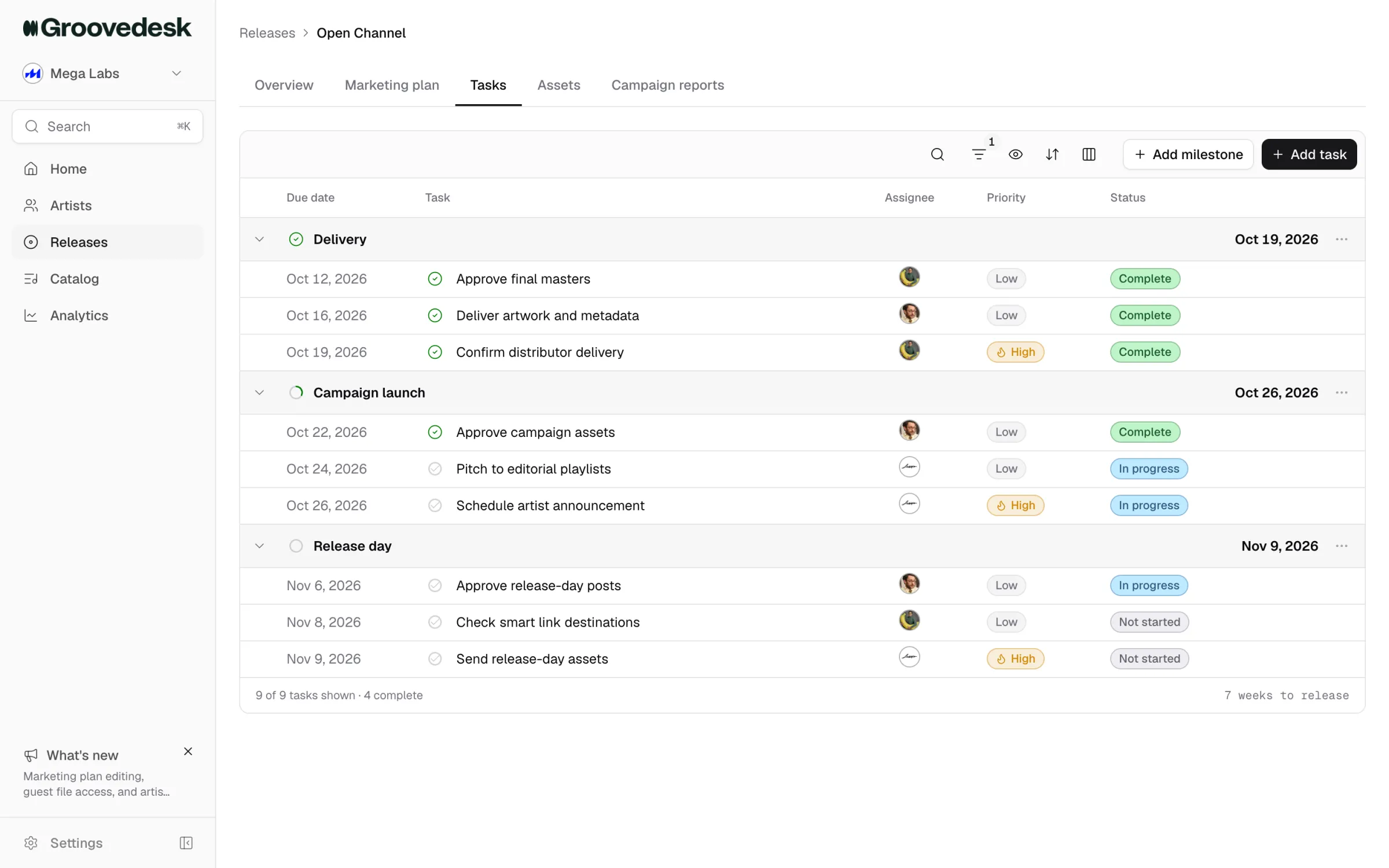
Let’s say you’ve got a single coming out in a couple months.
You create the release, pick a template and add the date. Every task lands with the right person, due on the right day. You barely have to think about it and it’s done.
Then there’s the marketing plan. Normally that’s a blank doc you struggle with for an afternoon, or a duplicate of the last release with the names swapped out.
Here all you need to do is talk. Tell Groovedesk what you’re thinking, and it drafts the plan for you. It uses your templates, your context and what it already knows about the artist: socials, tour dates, past releases, similar artists, and what playlists they’ve been added to. You just review it, change what you want and hit approve.
Everything about your release now lives in one place. When the publicist needs the bio and the press shots, it’s there. When the pitching team needs a quote and a preview link, it’s there. No more texts at 9:02 pm on a Thursday asking for the Linkfire.
And we built it so your entire team stays in the loop. Invite the artist, the manager and the publicist straight into the release. They only see what you choose to share.
Friday morning comes and the team wants an update? The numbers are right there, ready for you to send.
Less chasing, less copy-pasting, and more time for your artists.
What we believe
Your group chat isn’t a system. Nobody should have to dig through 48 unread messages to find the master, or get pinged dozens of times a day because two people are going back and forth over an asset. Releases deserve their own system, one place where everything lives.
Made for music. Not for everyone else. Asana doesn’t know what to do with an ISRC. Google Sheets doesn’t know when pitches are due. These tools aren’t made for music, so let’s stop trying to bend them in 10 different directions, pretending they are.
Music is multiplayer. Your software should be too. A single release can involve a dozen people at different companies. Every one of them should be able to see what they need without asking “where are we at?” and without you wondering if they can see more than they should.
You don’t need more. You need more room. Everyone’s always trying to get you to do more. More data, more content and more channels. But if you can barely keep up with what’s already there, how are you supposed to find time for more? Clearing the blockers gives you room to do better. Throwing more onto the pile doesn’t.
Working in music should be fun again. We all got into this industry because we love music. We’re building Groovedesk so you can fall in love with the job again. More time on music, less time on admin.
We think Groovedesk is the best way to release music. You open it up in the morning and you know exactly where every release is at without pinging the entire team or digging through endless spreadsheets. And pretty soon it’ll go beyond just being a source of truth. We’re connecting Groovedesk to the places where your work already happens and giving it the tools to get busywork done for you.
It doesn’t have to be this way.
We’re incredibly grateful to all the music teams that trusted us with the first version. Their feedback shaped this product. We’ve been heads down on the new Groovedesk for the last nine months, and we can’t wait to show you what we’ve been cooking.
The waitlist is now open. Join for early access and an extended 30-day trial before we launch later this fall.